
Levinson, author of The Silk Code and The Consciousness Plague, among others novels, brings us one of the more peculiar time travel books I’ve read. In it, a group of time travellers brought together by forces unknown—and you never really find out whom—conspire to rescue Socrates from hemlock poisioning at the hands of the Athenian democracy, bringing him to the future for the benefit of all mankind.
Right off the bat, it becomes clear that Levinson doesn’t have much interest in texture. He sketches his main characters in only the broadest strokes, and describes each of the times and places—ancient Athens, the far future, Victorian New York—in barest terms. Fight scenes are reduced to a few verbs and nouns. The time travel itself is accomplished by nondescript chairs; no flashy cars zipping along at 88 mph here. Levinson is in a hurry to get his characters moving and he has no patience for the particulars of how.
The author comes to the book under the assumption that the reader is up on the classics: you need to know who Socrates is, why he was killed, and, most important, why anyone would want to save him, to really appreciate The Plot. Though this information is eventually delivered in basic terms in the text, the only way you could derive any real emotional impact from the story would be if you brought this prior knowledge to the table. Levinson just doesn’t do the necessary legwork to get you invested.
Ironically, even though the stated purpose of each of the protagonists in the novel—the young classics grad student from 2042, her boyfriend, Heron of Alexandria, Alcibiades—is to save Socrates, Levinson devotes very little time to explaining why all of these people would spend years of their lives and risk life and limb to accomplish the goal of rescuing a septuagenarian philosopher of all the many things they could accomplish with time travel. The grad student, ostensibly the protagonist, goes from idle curiosity to full-on obsession with saving Socrates without an iota of genuine motivation. The hand of the author hovers ponderously over every event in the book. The characters act the way they do because that’s how they need to act for Levinson to make his point.
Levinson’s real interest is in the ramifications of time travel itself—it’s no accident that the protagonists are trying to save a philosopher, since philosophizing is what Levinson is interested in doing. What does it mean to be able to travel through time? How does it affect the meaning of life that one’s deeds can be unraveled by someone else? It’s an ambitious experiment in form that doesn’t quite work, but the story is fairly entertaining, if muted by lack of detail and texture, and Levinson does raise some thought-provoking ideas about cause and effect. If you enjoyed the circuitious indie time travel thriller Primer, you might get a similar kick here out of trying to figure out just what’s going on, even if you quickly get the sense that the answers aren’t there to find.
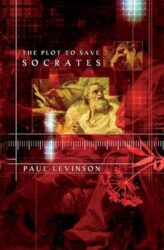 The Plot to Save Socrates (Sierra Waters Book 1) by Paul Levinson
Publisher : Tor Books; First Edition (February 7, 2006)
Hardcover : 271 pages
ISBN-10 : 0765305704
ISBN-13 : 978-0765305701
Genre: Time travel caper





The reviewer is certainly entitled to his views, but I have to wonder what they are teaching at Amherst College these days. Has Socrates become an obscure footnote as he suggests? Do readers really need to be “up on the classics” to have “prior knowledge” of “who Socrates is” and why people might want to rescue him from suicide?
Personally, I quite liked this book and had little trouble with limited forehand knowledge of Socrates. Also, with a more dealed treatment of each character I believe various plot points and/or holes would have emerged too early. I enjoyed the mystery of discovering the characters as much as the plot itself (if in fact they can be seperated:)) Just my thoughts. Thanks for the review.