
Summary: Huckleberry Lindbergh is returning home to New Seattle for the first time since his wife Abigail died. He’s not sure what he’s looking for or intends to find, but it seems like the right time to stop wandering. What he stumbles into, however, is nothing short of a plot to put a stop to the totalitarian government of New Seattle: the Health and Safety Department. And as he’s blundering his way through that, he finds what he originally came to town looking for: his life, rebooted.
Commentary: When I reviewed Outrageous Fortune earlier in the year, I referred to it as absurd . . . in a good way. Absurdist science fiction. Because it wasn’t laugh out loud comedy, it wasn’t The Hitchhiker’s Guide, but it sure wasn’t taking itself too seriously either.
While Love in the Time of Fridges is not a sequel to Outrageous Fortune, it is clearly its spiritual brother (with a WAY better title.) The world is equally outlandish. Only this time, the setting, now New Seattle, has been refashioned by safetymongers. There are signs everywhere warning citizens against stubbing their toes or being sad. Feeling the slightest suggestion of a bad day? Call the hotline to hear happy poetry. Are you sad? Look at this picture of a puppy. There are safety patrols who knock on people’s doors to inquire as to their state of safety and if there are any sharp corners that need taking care of.
It is a totalitarian state of a different kind. Rather than crushing citizens beneath an iron fist, it dopes them up on Prozac, wraps them in a featherbed, and plays Enya. The result is much the same: fear, oppression, and a populace that has no will for life.
Love shares some motifs with its predecessor: namely, weird methods for arresting citizens and experimentation with memory. Outrageous Fortune had Odysseus Hats, metal tubes clamped over victims to immobilize them as they are processed. In Love, citizens are wrapped in a sack up to their necks, chained, and hung from meat hooks attached to tracks that whisk them around like the clothes hanging up at the dry cleaners.
Part of being processed in New Seattle involves a head hack. This is where the government takes a look at the last 24 of your life, prints photos for evidence, and then proceeds with a mind wipe. This actually becomes a major point in the book, as the main characters’ relationships have to be remade following one such wipe.
Now to a bit of the plot. Huck encounters a woman named Nena, who he is convinced knows who he is or what he’s supposed to do better than he does. And on this hope that she can somehow restart his life, he follows her around the city and tries to help her in her quest. He doesn’t even know what that quest is, but it involves a gang of rogue talking fridges who like to sing. In order to save the fridges, Nena busts out of the police station, avoiding her head hack and making both she and Huck fugitives.
There are a number of smaller tangents going on in this book aside from Huck and Nena’s run from the law, and it is these that make me think this book is more confused than necessary. Somewhere about three-quarters of the way through, everything becomes convoluted. A previously unmentioned parallel world appears, which makes a book that had, until that point, been unrealistic but plausible turn into something else entirely. And what had been mostly a book about a chase and a mystery ceases to be about a chase and becomes something like a romance. Imagine The Fugitive having 5 minutes of Kimble falling in love with a DA at the end. Granted, Huck has been wanting to live again since returning to the city, but most of the action of the book is him trying to stay alive, stay free, and eventually put a stop to the Health and Safety regime.
When the plot with Health and Safety wraps up, or rather, when it is no longer Huck and Nena’s concern, there’s still more book to go, and I found this awkward. The main characters handed over the main plot. And then suddenly I was supposed to care deeply about Huck’s pain and his healing and how he and Nena will love one another after all. The problem with this is that I didn’t feel strongly about anyone in the book, except perhaps the fridges, who made me laugh. I couldn’t even tell you the kind of person Nena is, because I don’t know. And I don’t know how Huck could know either.
While I still think Tim Scott has some things going for him, a great imagination and a fine sense of irony, I think this book didn’t quite know what it wanted to be. And as a result, a lot of potentially great elements came together and ended up leaving me a little perplexed. Between “leave it on the shelf” and “buy copies for all your friends,” I’d give this one “borrow it from someone.” I would recommend Outrageous Fortune before Love in the Time of Fridges, though I do recommend keeping Tim Scott on one’s radar. Comedic sci-fi authors are rare, it seems, so it’s worth taking note when one comes along.
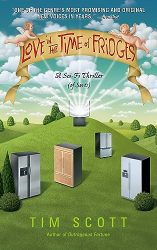 Love in the Time of Fridges by Tim Scott
Published by: Spectra (July 29, 2008)
ISBN-10: 0553384414
ISBN-13: 978-0553384413
Genre: Science Fiction