Commentary: The About the Author segment at the end of The Magicians and Mrs. Quent says this: What if there was a fantastical cause underlying the social constraints and limited choices confronting a heroine in a novel by Jane Austen or Charlotte Brontë? Galen Beckett began writing The Magicians and Mrs. Quent to answer that question.
I began reading this book with a question of my own: would infusing magic into a novel of manners produce a book that I would enjoy reading? Because in all honesty, although I have read Pride and Prejudice and Wuthering Heights, I didn’t enjoy either. It has long been my supposition that the reason canon books are canonical is because people feel they can relate to the characters or situations much more so than they can with books with “aliens” or “weird places.” And yet, I have nothing in common with a high class British woman who needs to find a suitable match and fills her days with parties, hat shopping, and making tea. The world of a Victorian romance holds nothing I can relate to, and the plots themselves held little interest.
Now magic… magic is something I have an interest in. Fantasy is something I have an interest in. Perhaps this addition could take that same kind of novel and add an element to grab my attention. I believe The Magicians and Mrs. Quent succeeds, but not for the reason I had imagined.
In the Victorian novels, the plots go something like this: high class woman in need of a husband meets a man she abhors, discovers his finer qualities, overcomes her reservations and marries him. And the story is a series of parties, meetings, conversations, and walks through the park that bring all this about.
Beckett’s plot goes something more like this: a woman from a failing family whose father has been driven insane by magic searches for a way to restore his sanity and keep her family from becoming poor, while stopping a coven of mad magicians from bringing unearthly destruction to the world and learning that the very land her country is founded upon seeks to bring down the government. And the story is a series of parties, meetings, conversations, and walks through the hinterlands, with additional scenes of action required to move that plot along.
So, it is not that Beckett simply added magic to Pride and Prejudice, he changed the plot while maintaining the trappings of the story. The prose itself sounds very much like Austen, keeping the reader at arm’s length. At times, seeming merely words on the page instead of a movie captured in paper. The characters are likewise proper with each other but well wrought. The main plot follows Ivy Lockwell and Rafferdy, who do very much model the destined lovers of the Victorian romance. But there is a second, almost juicier plot that follows Eldyn Garritt, an abused and destitute descendant from what was once a reputable family who wants desperately to raise himself up again. His story is cloak and dagger, introducing readers to the seedier and somewhat more fantastical side of life in Altania. Ivy brings readers manor houses and ghost stories. Eldyn brings readers highwaymen and circus acts, all key motifs from actual Victorian times.
This is what I think is key. Beckett lifts the motifs of the Victorian era, wraps himself in its garb, but writes himself a mystery-adventure. Events unfold slowly and the prose style means this is no quick read, but I do think the experiment is a success. And it is very clear from what happens that there are stories left to tell. Indeed, I am most hoping to return to Altania to see how Eldyn has made out. If the idea sounds interesting, I suggest readers give it a chance.
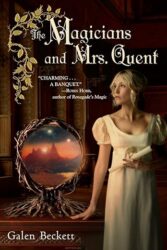 The Magicians and Mrs. Quent by Galen Beckett
Published by: Spectra (July 29, 2008)
ISBN-10: 0553589822
ISBN-13: 978-0553589825
Genre: Fantasy