
Cory Doctorow is perhaps best known as one of the bloggers behind Boing Boing, one of the most popular sites on the Web with zillions of hits and oodles of “whuffie” (influence/respect/mojo), a term Doctorow coined for his first novel, Down and Out in the Magic Kingdom. In addition to his regular blogging for Boing Boing and his own site, Craphound, he’s also the European Affairs Coordinator for the Electronic Frontier Foundation (EFF), doing more than his part to protect free speech and free Internet and all that good stuff for the rest of us geeks. I’ve read Boing Boing for years, but it wasn’t until recently, when I grabbed a free online copy of Down and Out, that I realized that Cory Doctorow is also one of the best and most imaginative SF authors working today.
Many of the best authors currently working in SF are rehashing the same old elements we’ve been grappling with in speculative fiction since the Industrial Revolution: space travel, time travel, and aliens. In other words, H.G. Welles and Jules Verne could still publish today, if someone thawed them out.
The cyberpunk revolution in SF that began in the 80s was so monumentally influential because, for the first time in a while, writers concerned themselves with the trends that were happening at the moment: body modification, increasingly intelligent computers, etc. We had begun to redefine what it meant to be human and cyberpunk SF mined the possibilities for all they were worth.
Of course, the bulk of cyberpunk ended up being about cool clothes and nifty sunglasses, but the movement did a lot to bring SF back to the here and now, exploring contemporary issues in the way that only speculative fiction can.
What cyberpunk did for the Eighties, Cory Doctorow does for the Oughties (00-ies?). He plumbs the thematic issues raised by the technological capabilities we are poised to develop today. In Someone Comes to Town, Someone Leaves Town, Doctorow goes a step further, limiting his story to the actual nitty-gritty tech that works right now, making you wonder if this should really be classified as SF at all. His main character, Alan (or Albert or Adam or any of a number of A-names, they shift randomly throughout the book) is trying to set up a WiFi commons in Toronto. He pursues this agenda with routers and PC’s rescued from trash bins — in other words, everyday tech. In one respect, the book is a polemic for free WiFi, which makes sense considering Doctorow’s EFF role.
What’s more surprising is that Someone Comes to Town is also a work of magical realism, a lovely fantasy tale interwoven with Alan’s more mundane struggle to provide free Internet access. You see, Alan’s father is a mountain and his mother is a washing machine. His brothers are a fortune teller, a dead man, an island, and three nesting Russian dolls. Sounds crazy, but Doctorow’s prose is so assured and his storytelling is so deft that you accept all of this as the modern fairy tale it’s meant to be.
When Alan’s vicious and cruel dead brother, Danny (or David or any of a number of D-names) returns for vengeance (Alan and the other brothers killed him), Alan is forced to juggle his responsibilities toward the WiFi project, his own attempts at writing a short story, his budding romance with Mimi (a beautiful neighbor who happens to have large, bat-like wings) and his own survival. (Sounds like a typical day for Cory Doctorow, actually.)
This is a book that will appeal mostly to geeks, both because it’s SF and because it dwells so enthusiastically on the topic of wireless connectivity and networks and all that. But above and beyond those trappings, Someone Comes to Town, Someone Leaves Town is about family and society: fitting in, feeling left out, struggling for acceptance, struggling for independence. Highly recommended, a real page-turner. You’ll be thinking about the ideas Doctorow writes about for days after reading it.
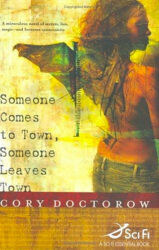 Someone Comes to Town, Someone Leaves Town by Cory Doctorow
Publisher : Tor Books; First Edition (July 1, 2005)
Hardcover : 320 pages
ISBN-10 : 0765312786
ISBN-13 : 978-0765312785
Genre: Science Fiction / Fantasy / Magical Realism


Good review, David!
This is a really great book.