Some books I know I’m going to love within the first few pages. Other books I discard in a few paragraphs. And then there are the books where I can’t put them down, yet I also can’t decide at the end if I liked them or not.
Tony Ballantyne’s Recursion fits that latter category.
One complaint I have about many futuristic SF novels is that the future depicted within the pages isn’t that much different than our own present. Sure, the technology is advanced, but it doesn’t seem that advanced to me. I mean, picture bringing an 18th century watchmaker into the control tower of any major airport today. Where you once had techno savvy guy, you’d now have an awestruck bystander without the grounding to grasp what is going on around him. That’s pretty much how I think the future will be — we’re morons if we think we’d have any chance of grasping the more esoteric nature of things if we were thrust there unaware.
That’s how I see myself in recursion — thrown into an unimaginable world where nanotech, self-replicating machines and all-powerful AIs rule. I had a tough time following the three timelines presented in the book, probably because I was trying to grasp what connected each together. The clues were there — I just struggled to make the connections.
And I don’t think this was a fault of the author. Indeed, the story telling was top notch, the action nail-biting and the character development quite rich. There are no plot holes I can find and the material is fresh. What it all boils down to is, I’m hesitant to say, that I don’t think I’m smart enough to have really enjoyed this book fully.
Would I recommended it? Absolutely. Assuming that you’ve had more than the average education afforded in this country and don’t mind having your expectations stretched a bit. It’s not for casual readers. If ever there was a book that demanded an IQ test before wading in — this is it.
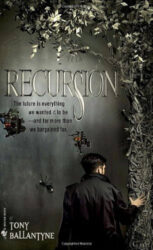 Recursion by Tony Ballantyne
Published by: Bantam Spectra (August 2006, mass market edition)
ISBN-10: 0553589288
ISBN-13: 978-0553589283
Genre: Science Fiction