
I have two distinct things to talk about with this book, and I can’t think of a smooth way to integrate them, so I won’t.
1. In her book Bitch, Elizabeth Wurtzel talks about “difficult women.” These are the women who, put simply, no one knows how to deal with. They change their minds and demand the right to do so. They are not nice, they are not quiet, they do not do what they are told. These women, Wurtzel says, are the ones that a society run by men rejects, and so they are demonized. They’re wild women, bad women, whores and witches. We like nice girls, soft girls, girls who suffer their place and try to make friends. We kill the other kind.
Hekat, in Empress, is a difficult woman. And while I know that a part of me should cheer for this woman who raises herself up from a nameless no one to a ruler of her country, the other part of me can’t stand how difficult she is. Hekat is touched by the god. She is not inventing this. She really does have her deity on her side, protecting her as she slaughters the people who get in her way. Everything she does is fated. But I cannot get beyond how completely cold and ruthless she is to everyone around her.
Hekat has a single-mindedness that is frightening. Everyone who does not help her in her quest to rule Mijak is worthless—as good as dead and damn lucky if she doesn’t kill them herself. Even the people who love her do so at their own peril. And they get no kindness or love in return for what they give. She has one friend in the world, and she nearly cuts his throat a number of times.
Her fanaticism and disdain make her unlikable. And call me old fashioned, but I want to like my main character. I want to think she’s doing something good in the world. All I have in Hekat is the fist of a god, tearing out hearts in relentless pursuit of material goals. Hekat will have a son. She will make her son emperor of all Mijak. Her son will spread belief in the god to the godless lands. He will kill any who resist him. And even he will not be spared her harsh contempt if he shows any doubt in the worthiness of this goal. He will kill because she tells him to, and she is never wrong, cannot be wrong, because the god speaks to her.
It is hard to like or even care about such a woman. Would it be different if Hekat were a man? I can’t say. But I can say that I had to force myself to continue spending time with a woman that I felt so contemptible, even though I also recognize that the reasons I found her contemptible were based in societal conditioning.
2. Unlike Miller’s previous books, The Innocent/Awakened Mage, Empress does not focus so much on relationships to tell its story. Empress is a novel built on plot and style. And the style, here, tells readers a lot. Mijak is a harsh desert land, and its people are bloodthirsty and violent. This comes through as much in Miller’s language as it does in the scenes she describes.
There are no churches in Mijak, for instance. There are “godhouses.” There are no priests, but “godspeakers.” The army is the “warhost,” which is led not by a general but a “warleader.”
There are many terms throughout the book that are constructed this way. They are compound words made up from short, simple concepts. The effect is one of a simple, brutal people slowly inventing more complicated concepts for themselves.
This brutality permeates Mijak culture. It’s not only in their language, but in their religion. Animal sacrifice is nearly constant. Thousands upon thousands of animals are slaughtered throughout the book. The highest priest in the land reads the future in entrails. People of rank drink blood as part of religious ritual. And the reader is constantly reminded that the god of Mijak really does require these sacrifices. It is not mere belief on the part of the people; they have proof through the daily intervention of the divine, which makes their brutality reasonable, even understandable.
It is to Miller’s great credit that readers can intuit the nature of Mijak from the first page. Her diction creates a profound effect—one that I’m not sure I’ve ever encountered with quite the same intensity. I knew, from the moment I started reading, the kind of civilization I was going to encounter before it was ever shown to me. I could feel it in the language. And that is artistry at its best.
So the question is: Do I recommend this book? I think there is obvious skill in the writing. And I believe that we need to see more ruthless women, just precisely because it is uncomfortable, because it flies in the face of convention and demands that we face up to our biases. But I don’t know that I ultimately enjoyed what I read. And I don’t see me running out to pick up the next book in the series. As a feminist novel, I think Miller is right on the money. Hekat is the living embodiment of challenging the patriarchy. But as escapist fiction, I think Empress might be more demanding than most readers would expect.
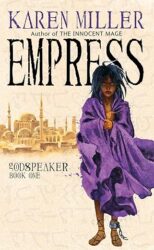 Empress (Godspeaker, Book 1) by Karen Miller
Publisher : Orbit (April 1, 2008)
Paperback : 717 pages
ISBN-10 : 0316008354
ISBN-13 : 978-0316008358
Genre: Fantasy




I’m also reading this book, and like Lora I need to like the main character to really enjoy the book… or at least like one of the characters. And in this book there are not many characters that I like. Except maybe Hekat’s son.
I think this book will aquire his value in the context of the full trilogy. I think it was a very bold move on Miller’s part to start a series with such an unlikable character. And this is the reason why I would recommend this book. I really think we need to encourage authors who try differents ways to tell stories.
I’d love to hear what you think of the whole series, Isabelle. Given how much I have to read, I don’t know that I have the time to try the next one just to see if it all pans out in the end. But if you do read them all, you should definitely do a write up.
You make a good point about supporting authors who try different things, though. And if it turns out that the trilogy ends up being worth it, then perhaps I’d take it back.